Why Tract Homes Are a Different Animal for Insurance
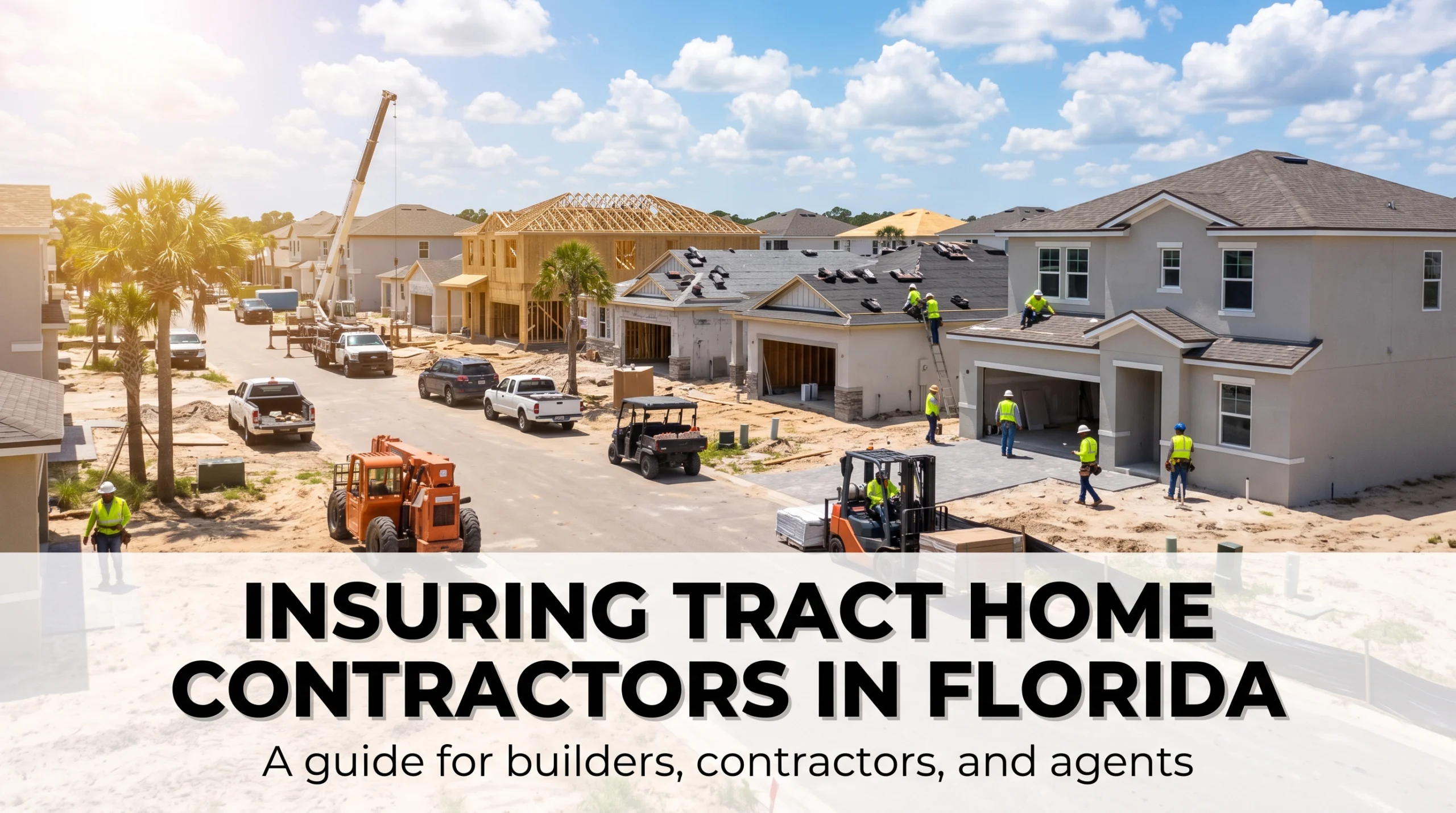
Northeast Florida is building houses at a pace we have not seen in years. Drive through Nocatee, SilverLeaf, the Durbin Park corridor, or out toward Yulee and you will see entire subdivisions going vertical at once — the same handful of floor plans, the same materials, the same crews moving lot to lot.
That model is efficient for builders. For insurance, it creates a very specific set of problems. When a contractor does the same work the same way on 200 homes, one mistake does not stay one mistake. It becomes 200 claims.
If you are a general contractor, framer, roofer, plumber, electrician, HVAC, drywall, stucco, or concrete sub working on tract or production homes, here is what you need to know about getting your insurance right — and where we see contractors get burned.
1. Volume and Repetition Multiply Every Mistake
In custom building, a defect is usually a one-off. In tract building, the same method, the same product, and often the same crew are used on every unit. If a plumbing fitting is installed wrong, a window flashing detail is missed, or a stucco system is applied too thin, that error is baked into every house in the phase.
That is exactly why carriers get nervous. They are not pricing one claim — they are pricing the possibility of a whole subdivision of identical claims hitting at once, often from an HOA or a group of homeowners represented by the same law firm.
What it means for you: Underwriters will ask how many units you do per year, what percentage of your work is tract vs. custom, and who the builders are. Answer accurately. Understating your tract work to get a cheaper quote is the fastest way to have a claim denied for misrepresentation or excluded by a tract housing endorsement you did not know you had.
2. Completed Operations: The Long Tail
Most tract home claims do not show up while you are on the job. They show up after closing, once a family has lived in the house for a few years — foundation and slab cracks, water intrusion around windows, roof leaks, plumbing failures, electrical problems.
That is the products-completed operations part of your general liability policy, and it needs to be in place long after the work is done. In Florida, the statute of repose for construction defect claims was shortened from 10 years to 7 years in 2023 (SB 360), generally measured from the earliest of the certificate of occupancy, completion, or abandonment. Seven years is still a long tail.
Florida also has a pre-suit process under Chapter 558, which requires a homeowner or association to send a notice of construction defects and give contractors a chance to inspect and repair before filing suit. Those 558 notices need to go to your carrier immediately — late notice is one of the most common reasons coverage gets contested.
3. Shared Liability on a Crowded Job Site
A tract development can have a developer, a national or regional builder, a dozen trade subcontractors, and multiple suppliers all touching the same house. When something goes wrong, everyone points at everyone else, and every party gets named in the suit.
Florida has largely moved away from joint and several liability toward comparative fault, but that does not keep you out of the lawsuit. You will still be named, you will still need a defense, and defense costs on multi-party construction defect suits add up fast. A policy with defense costs outside the limits is worth asking about.
4. Construction Defects and Workmanship
Water intrusion, stucco failure, roof leaks, HVAC and insulation problems, and slab issues are the usual suspects in Florida production housing. Our humidity, rain, and hurricane season make water-related defects especially common.
One important distinction: general liability is designed to cover resulting damage — the rotted framing, ruined drywall, and mold damage caused by the defect — not the cost to redo your own faulty work. Watch for these policy provisions that can gut coverage on residential work:
| Exclusion / Endorsement | What It Does | Why It Matters on Tract Work |
|---|---|---|
| Tract / Production Housing Exclusion | Excludes work on developments over a set number of units | Can eliminate coverage for your largest jobs entirely |
| Residential Construction Limitation | Excludes or restricts all residential work | Often found on cheaper GL programs built for commercial trades |
| Subcontractor Exclusion or Warranty | Voids coverage if subs lack their own insurance | One uninsured sub can wipe out your coverage on a claim |
| Fungi / Mold Exclusion | Excludes mold and bacteria damage | Water intrusion claims in Florida almost always include mold |
| Prior Work / Continuous Damage Exclusion | Excludes damage from work done or damage that began before the policy | Dangerous for contractors switching carriers mid-development |
| Classification Limitation | Limits coverage to listed trade classes | A framer who also sets windows may not be covered for the windows |
5. Builder Contracts and Insurance Requirements
Production builders hand subcontractors a master subcontract agreement with insurance requirements that are often non-negotiable. Common requirements include:
Your certificate of insurance does not create coverage — your policy endorsements do. If the builder’s contract requires completed operations AI and your policy only has an ongoing operations AI endorsement, you are in breach of contract and personally exposed. Send us the contract before you sign it so we can match the policy to the requirements.
Some large builders also run a wrap-up program (OCIP or CCIP) that insures all trades under one policy for that project. Wrap-ups have their own gaps — they typically end at project completion, may not cover your off-site work or equipment, and you need to make sure you are not paying for coverage in your bid that the builder is already providing.
6. Subcontractors and Workers’ Compensation
On a tract job, the general contractor or builder depends on dozens of subs — and their mistakes become your problem. That is especially true for workers’ compensation in Florida.
Under Florida law (s. 440.10, F.S.), a contractor is the statutory employer of its subcontractors’ employees. If your sub does not carry workers’ comp and one of their workers is hurt on your job, that claim lands on your policy. If you do not have coverage, you are facing the claim plus a potential stop-work order and penalties from the Division of Workers’ Compensation.
It also shows up at audit. Any uninsured sub you paid can be added to your payroll and charged premium at your carrier’s rates — often at high construction class codes. A surprise audit bill of tens of thousands of dollars is a real possibility.
7. Environmental and Pollution Exposures
Land clearing, grading, and site work on large developments create exposures most contractors do not think about: sediment and stormwater runoff into neighboring property or wetlands, dust complaints, and mold from moisture trapped during construction. Florida’s wetlands and stormwater rules make runoff a real regulatory risk.
Standard GL policies carry a broad pollution exclusion, and many also exclude mold. Site work contractors, and any trade with meaningful water or mold exposure, should price out a Contractors Pollution Liability (CPL) policy. It is often less expensive than contractors expect, and some builders now require it.
8. Capacity, Pricing, and the Florida Market
Not every carrier wants residential construction, and fewer still want tract work. Florida’s litigation environment and construction defect history mean many standard carriers will decline the risk outright, which pushes contractors into the excess and surplus (E&S) market.
E&S coverage is not bad coverage — but it is less standardized. Forms vary carrier to carrier, and that is where tract exclusions, subcontractor warranties, and residential limitations tend to hide. Higher premiums and deductibles are common, so build realistic insurance costs into your bids instead of finding out at renewal.
9. Warranties and Post-Closing Callbacks
Production builders give homebuyers a warranty and then push repair obligations down to the trade that did the work. Callbacks for HVAC, plumbing leaks, drywall cracks, and roof issues can go on for years.
Your GL policy generally does not pay for warranty work or to fix your own defective work — it responds to property damage or bodily injury that results from it. Know the difference, budget for warranty callbacks as a cost of doing business, and do not assume every callback is an insurance claim.
The Tract Home Contractor’s Insurance Checklist
Here is the core coverage package we look at for contractors working on production and tract homes in Florida:
| Coverage | What to Check |
|---|---|
| General Liability | No tract/residential exclusion, completed ops included, AI endorsements for ongoing and completed ops, primary & non-contributory, waiver of subrogation |
| Workers’ Compensation | Correct class codes, uninsured sub exposure managed, waiver of subrogation available |
| Commercial Umbrella / Excess | Limits that meet builder contracts; follows form on completed ops and AI |
| Commercial Auto | All trucks and trailers scheduled, hired & non-owned auto for employees’ vehicles |
| Builder’s Risk | Who carries it (builder or contractor), windstorm and theft coverage, transit and stored materials |
| Inland Marine / Equipment | Tools and equipment on site, scheduled vs. blanket limits |
| Contractors Pollution Liability | Mold, runoff, and site work exposures not covered by GL |
Let’s Make Sure Your Coverage Matches Your Work
Tract and production home work can be a great business, but the insurance has to be built for it. A cheap policy with a tract housing exclusion is not a savings — it is an uninsured loss waiting to happen.
At Frye Insurance Agency, we work with contractors across Jacksonville and Northeast Florida on general liability, workers’ compensation, builder’s risk, and the contract requirements that come with production building. Send us your current policy and your builder’s subcontract, and we will review them side by side and show you exactly where the gaps are.
This article is for general informational purposes only and does not modify any insurance policy. Coverage depends on the specific policy language, endorsements, and facts of each claim. Consult your agent and, for legal questions, an attorney.