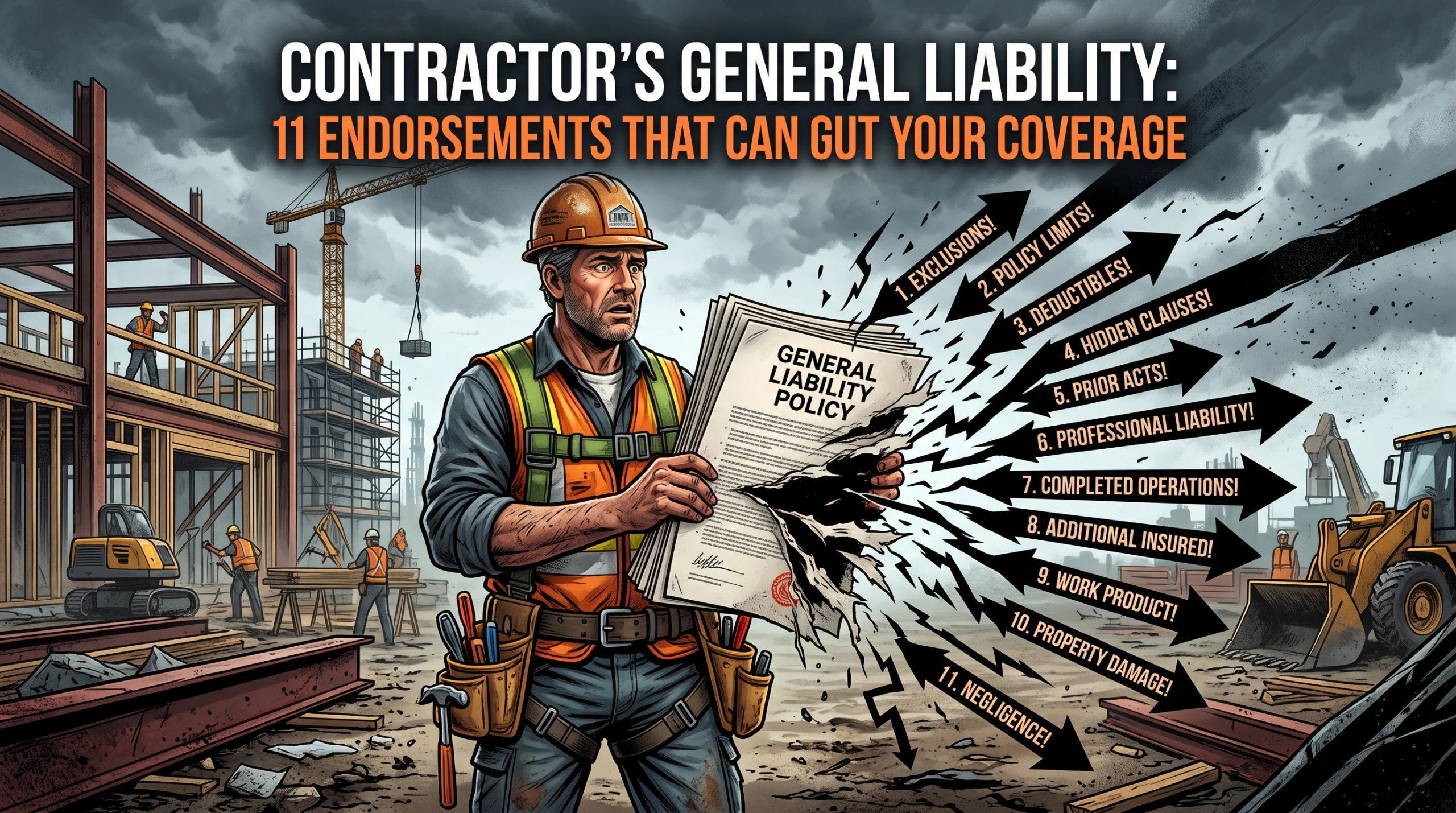
Most contractors shop general liability on two things: the premium and whether the certificate will satisfy the GC or project owner. Both matter. But the part of the quote that decides whether a claim actually gets paid is the list of endorsements stapled to the back of the policy — and in today’s construction market, especially with excess and surplus (E&S) carriers, that list can quietly remove coverage your contracts assume you have.
Before you compare price, compare the forms schedule. One bad endorsement can wipe out the coverage your contract requires.
PLEASE NOTE: A Carrier can refuse and/or charge additional premium to modify or remove one of these endorsements.
Below are 11 of the most common limitation endorsements we see on contractor GL policies, what each one does and why it matters at renewal. We’ve added Florida-specific notes where state law changes the picture.
The 11 Endorsements to Watch For:
1. Injury to Employee Endorsements
What it does: The standard CGL already excludes bodily injury to your own employees (that’s what workers’ comp is for), but it gives back coverage for liability you assume under an “insured contract.” This endorsement takes that give-back away.
Why it hurts: It kills coverage for “action over” claims — where your injured employee sues the GC or owner, and they turn around and pass the claim to you under your indemnity agreement.
2. Subcontractor / Independent Contractor Injury Endorsements
What it does: Excludes bodily injury to employees of your subcontractors or independent contractors.
Why it hurts: On a jobsite, the people most likely to get hurt often aren’t your employees — they’re your subs’ employees. This endorsement leaves you uninsured for exactly those claims and conflicts with the indemnity language in most construction contracts.
3. Classification Limitation Endorsements
What it does: Limits coverage to the operations described by the ISO class codes on the declarations page.
Why it hurts: Contractors rarely do only one thing. A roofer who installs gutters or a remodeler who does a little concrete work can find a claim denied because that incidental work wasn’t in the classification.
4. Contractual Liability Limitation Endorsements
What it does: Removes coverage for tort liability you assume under a contract (the “insured contract” definition gets gutted).
Why it hurts: Virtually every construction contract has a hold-harmless / indemnification clause. Without contractual liability coverage, those promises are backed by your company’s balance sheet instead of your insurer.
5. Cross Suits Exclusions
What it does: Excludes suits between insureds — and broad versions include additional insureds.
Why it hurts: If the project owner or GC you named as an additional insured sues you, there may be no coverage.
6. Damage to Work Performed by Subcontractors on Your Behalf
What it does: Removes the standard exception that restores coverage for damage to your completed work when the damaged work (or the work that caused it) was performed by a subcontractor.
Why it hurts: For a general contractor, this can all but eliminate meaningful completed operations coverage for construction defect claims.
7. Subcontractor Warranty / Independent Contractors Limitation
What it does: Makes coverage conditional on your subs meeting requirements: written indemnity agreements, current certificates of insurance, minimum limits, and naming you as an additional insured.
Why it hurts: Miss one certificate and the penalty may be anything from a higher deductible to no coverage at all for that sub’s work.
8. Prior Work Exclusions
What it does: Excludes claims arising from work completed before the policy’s inception date.
Why it hurts: Construction defect claims surface years later. When you switch carriers and the new policy excludes prior work, your entire history of completed jobs can be left uninsured.
9. Subsidence / Earth Movement Exclusions
What it does: Excludes damage caused by settling, sinking, shifting, or other earth movement.
Why it hurts: Foundation, excavation, site work, and ground-up builders are hit hardest. In Florida, sinkhole-prone soils make this more than theoretical.
10. Residential Exclusions
What it does: Excludes residential work — sometimes all of it, sometimes specific types like condos, townhomes, tract homes, or new residential construction.
Why it hurts: A commercial contractor who takes an occasional residential job, or a remodeler who works on a condo building, can be uninsured on that job without realizing it.
11. Total Pollution Exclusions
What it does: Replaces the standard ISO pollution exclusion with one that removes its built-in exceptions — such as products-completed operations and fuel or fluid releases from mobile equipment.
Why it hurts: A ruptured hydraulic line, a fuel spill, or fumes from coatings can become an uninsured claim.
What Florida Contractors Should Know
- Indemnity agreements still bite. Florida Statute 725.06 limits how far construction indemnity clauses can go and requires a monetary cap, but the obligations that survive are exactly what contractual liability coverage is supposed to back.
- Uninsured subs are your problem twice. Under Florida’s workers’ comp law (Statute 440.10), a contractor can be treated as the employer of an uninsured sub’s workers.
- Defect claims have a long tail. Florida’s statute of repose for construction defect claims is now 7 years (shortened from 10 in 2023). That’s still seven years of completed jobs that a prior work exclusion or a subcontracted-work exclusion can leave exposed.
- Residential and condo work is tightly underwritten here. Florida’s construction defect climate means residential and condo exclusions show up often on contractor policies, especially in the E&S market.
Before You Sign Your Next GL Renewal
A cheaper policy that doesn’t respond to the claims your contracts expose you to isn’t a savings. At Frye Insurance Agency, we review the forms, not just the price, and we’ll tell you plainly which endorsements are worth fighting. Learn more about our general liability coverage, or reach out for a no-cost review of your current contractor policy.
Source material: Gary Grindle, “Contractor’s General Liability: 11 Common Coverage Limitation Endorsements,” Amwins, June 2024. This article is general information, not legal advice; coverage is determined by the actual policy language.