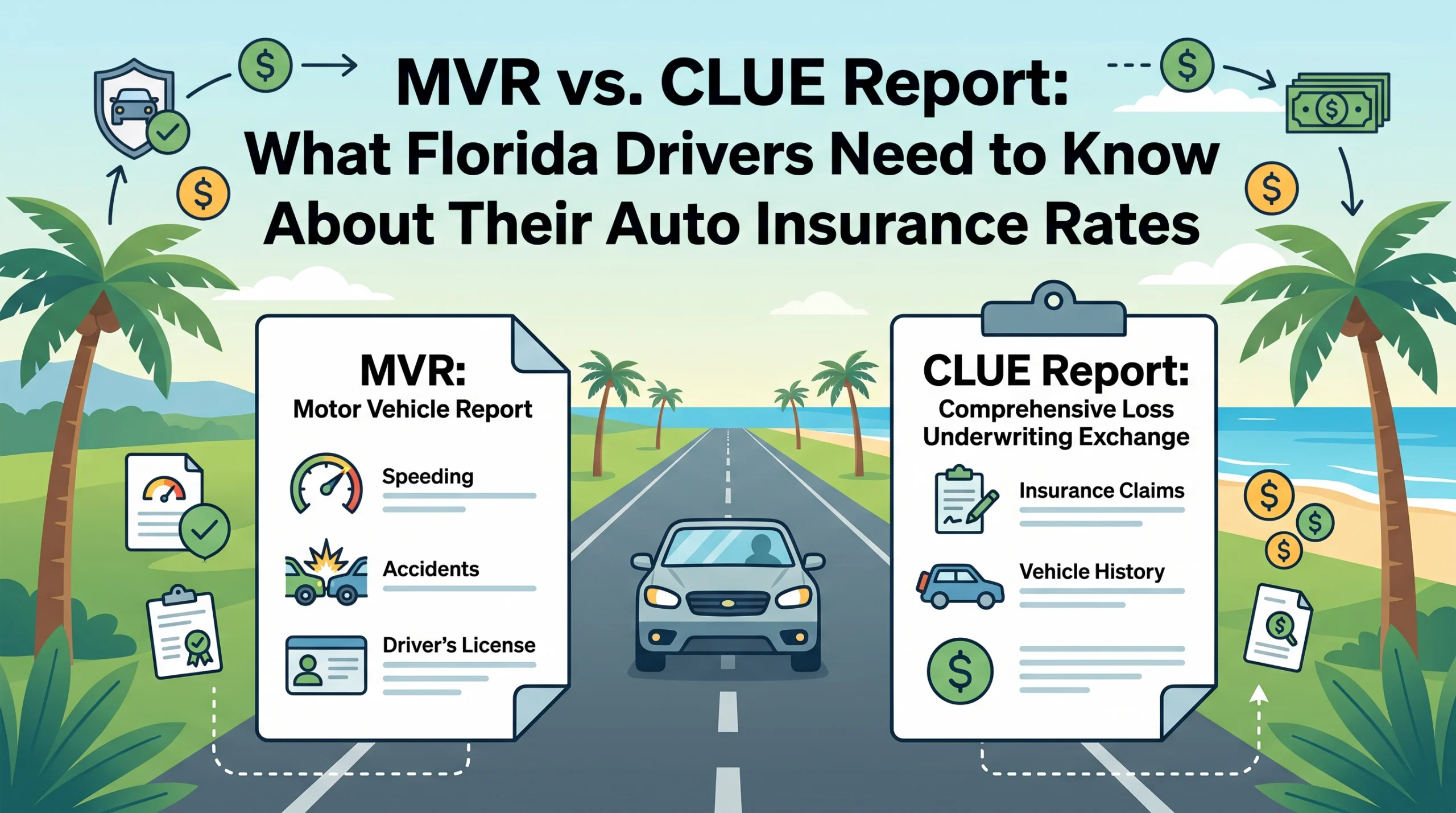
Every time you shop for car insurance, the carrier is looking at more than your age, your ZIP code, and the vehicle you drive. Behind the scenes, underwriters pull two reports that tell them how you drive and how often you file claims: your Motor Vehicle Report (MVR) and your CLUE report.
Most drivers have never seen either one, yet together they can be the difference between a preferred rate and a surcharge. Here is what each report is, how they differ, how they affect your premium in Florida, and what you can do to keep them clean.
MVR vs. CLUE Report: Side-by-Side
| MVR | CLUE Report | |
|---|---|---|
| Who maintains it | State DMV (FLHSMV in Florida) | LexisNexis Risk Solutions |
| What it tracks | Tickets, convictions, points, license status | Insurance claims and payouts |
| How far back | Points 3 years; violations several years; DUI 75 years in Florida | Up to 7 years |
| What it tells an insurer | How you drive | How often you file claims and how costly they are |
| How to get a copy | FLHSMV, for a small fee | LexisNexis consumer portal, free once a year |
| Where to fix errors | The clerk of court or FLHSMV | LexisNexis dispute process |
How Each Report Affects Your Auto Insurance Rate
Your MVR drives eligibility and surcharges. A clean record usually qualifies you for safe-driver and preferred-tier pricing. A single minor ticket may cost you that discount; multiple violations or a major conviction like a DUI can push you into a non-standard market or make you ineligible with some carriers altogether.
Your CLUE report drives loss history. Carriers look at both how often you file and how much was paid. Several small claims in a short window can hurt as much as one large one, because frequency is a strong predictor of future losses.
The two reports stack. Underwriters read them together. A speeding ticket on your MVR plus an at-fault collision on your CLUE within the same period paints a much riskier picture than either item alone, and the rating impact compounds.
Gaps in coverage matter too. A lapse in insurance is not on either report, but carriers check prior coverage separately. Even a short gap can cost you a continuous-coverage discount.
How to Get Copies of Your Reports
Your Florida MVR: Order it online through FLHSMV or by mail with form HSMV 90511. A 3-year record runs about $8 and a 7-year or complete record about $10. You will need your driver license number and date of birth.
Your CLUE report: Under the Fair Credit Reporting Act (FCRA), you are entitled to one free copy every 12 months from LexisNexis. Request it through the LexisNexis consumer disclosure portal or by phone. You are also entitled to a free copy if an insurer takes adverse action against you based on the report.
It is smart to pull both before you shop for coverage so there are no surprises when a carrier runs them.
What to Do If You Find an Error
CLUE errors are more common than people expect: a claim attached to the wrong driver, an inquiry logged as a paid claim, or a payout amount that is wrong. File a dispute with LexisNexis. Under the FCRA they generally have 30 days to investigate and correct or remove information that cannot be verified. Keep copies of claim letters, repair invoices, and police reports to support your case.
MVR errors, such as a dismissed ticket still showing as a conviction or points that should have been withheld after traffic school, are handled at the source. Contact the clerk of court in the county that issued the citation, get documentation of the correct outcome, and follow up with FLHSMV to make sure the record is updated.
Tips to Keep Both Reports Clean
Not Sure What Your Reports Say? We Can Help.
At Frye Insurance Agency, we review driving and claims history with our clients every day. As an independent agency in Jacksonville, we can shop multiple carriers to find the one that weighs your record most favorably, and help you understand what is driving your premium. Learn more about our personal auto insurance options, or reach out for a free quote.