Something significant just happened in the commercial insurance market. According to the latest data from The Council of Insurance Agents & Brokers (CIAB), overall commercial P&C premiums declined by an average of 1.2% in Q1 2026 — the first decrease since the third quarter of 2017. After years of steep rate increases, the market is shifting. If your premiums have not moved recently, you may be leaving money on the table.
What Changed — and Why It Matters
The hard market that dominated commercial insurance through most of the early 2020s was driven by catastrophe losses, social inflation, and carriers pulling back capacity. That environment pushed premiums up for 33 consecutive quarters. Now, the dynamic is reversing. More carriers are competing aggressively for business. Underwriting appetite has expanded. Terms and conditions are loosening. That is good news for Florida business owners who have absorbed significant premium increases over the past few years.
Here is how the major commercial lines moved in Q1 2026:
COMMERCIAL PROPERTY
-5.5%
Sharpest decline of any line; increased capacity cited
WORKERS COMP
-3.7%
Continued multi-year downward trend
CYBER LIABILITY
-3.5%
Significant softening after years of sharp increases
COMMERCIAL AUTO
+5.8%
59th consecutive quarter of increases
BIZ INTERRUPTION
-1.9%
Favorable movement after COVID-era tightening
D&O LIABILITY
-2.1%
Broad excess/surplus market competition
UMBRELLA / EXCESS
+4.8%
Social inflation and nuclear verdicts driving costs
GENERAL LIABILITY
+2.6%
Moderate increases continue across most classes
A Closer Look at the Lines That Matter Most Here in Florida
Commercial Property — The Biggest Opportunity
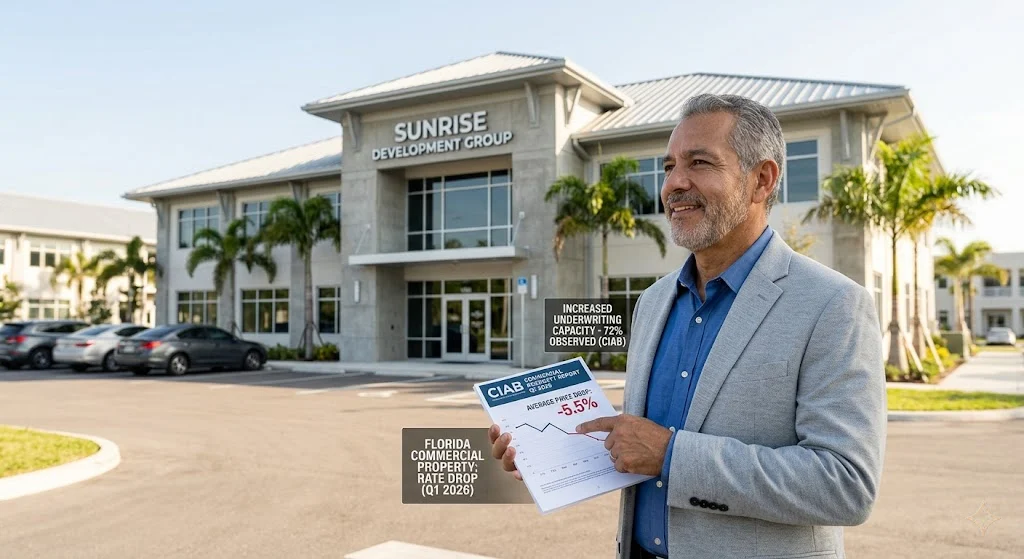
Commercial property saw the largest price drop of any line, falling 5.5% on average in Q1 2026. For Florida business owners who weathered dramatic property rate increases over the past several years — especially post-Ian and post-Idalia — this is a meaningful shift. The CIAB report noted that 72% of respondents observed increased property underwriting capacity, with some describing the increase as “significant.”
Your results will depend on your specific location, construction type, roof age, and loss history. But the market is more receptive to competition right now than it has been in years — which is exactly when you want a broker actively shopping your account.
Workers Compensation — Continued Relief
Workers comp premiums declined 3.7% in Q1 — continuing a multi-year favorable trend for employers. Florida has historically been one of the more expensive WC states, so any downward movement is welcome. If your WC has not been re-marketed in the past 12 months and your payroll or classification mix has changed, there is room to improve your rate.
Commercial Auto — Still Climbing
Commercial auto is the clear outlier, posting its 59th consecutive quarter of rate increases at +5.8%. AM Best has called it “one of the worst-performing P&C segments over the last ten years.” The structural drivers — social inflation, nuclear verdicts, distracted driving, and rising repair costs — have not gone away. If you operate vehicles, driver safety programs, telematics, and the right carrier for your fleet class can all influence your outcome.
General Liability and Umbrella — Watch Your Limits
GL and umbrella are still seeing increases (2.6% and 4.8% respectively). More importantly, the adequacy of your limits deserves a hard look. Nuclear verdicts — jury awards in the tens of millions — are reshaping what “adequate” umbrella coverage means in Florida. If your umbrella limit is where it was five years ago, it may not be enough today.
What You Should Do Right Now
A softening market does not automatically mean your renewal comes down. Carriers do not proactively lower your premium — you have to go get it.
How Long Will This Last?
Soft markets do not last forever. Whether this cycle extends through the rest of 2026 will depend on catastrophe losses, litigation trends, and underwriting profitability. An active hurricane season, a wave of nuclear verdicts in Florida courts, or a shift in carrier appetite could reverse conditions quickly. The window is open now — the businesses that benefit most are the ones that act while it is soft.