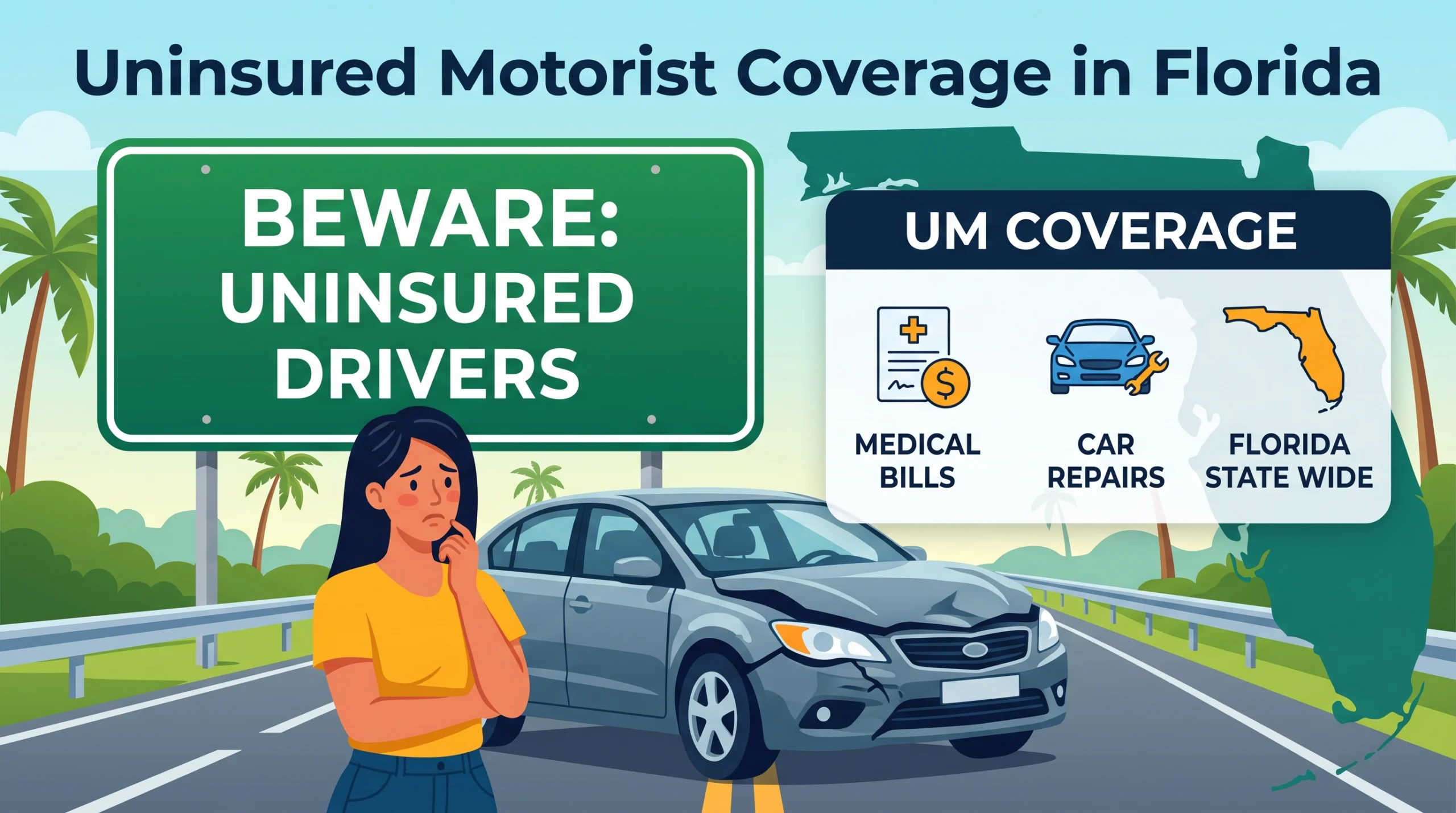
Here is an uncomfortable number for anyone who drives in Jacksonville: roughly one in five Florida drivers has no auto insurance at all. The Insurance Research Council put Florida’s uninsured rate at 20.6% in its 2017–2023 study — the seventh-highest in the country, and well above the national average of 15.4%. Add the drivers who carry insurance but nowhere near enough of it, and the odds that the person who hits you cannot pay for what they did are uncomfortably high.
Uninsured motorist coverage is the answer to that problem. It is also, dollar for dollar, one of the most valuable coverages on a Florida auto policy — and one of the most commonly declined.
What Is Uninsured Motorist Coverage?
Uninsured motorist coverage — UM for short — is coverage you buy on your own policy that steps into the shoes of the at-fault driver when that driver has no insurance. If an uninsured driver runs a red light on Atlantic Boulevard and puts you in the hospital, you do not sue an empty pocket and hope for the best. You file a claim under your own UM coverage, and your insurer pays what the at-fault driver should have paid.
A few things make it unusually good value:
Uninsured vs. Underinsured: Two Problems, One Coverage
Uninsured means the at-fault driver carried no bodily injury liability coverage at all. Underinsured means they had coverage, but their limits were too small to cover the harm they caused — a $10,000 limit against a $90,000 hospital bill, for example.
In Florida these are almost always sold together as a single UM/UIM coverage, so you do not have to guess which situation you will find yourself in. Nationally, the same research found about 18% of drivers were underinsured. Stack that on top of the uninsured, and roughly one in three drivers on the road cannot fully pay for a serious crash they cause.
One important Florida-specific note: UM here is bodily injury coverage only. Florida does not offer uninsured motorist property damage the way some states do. Damage to your vehicle from an uninsured driver is handled through your collision coverage, subject to your collision deductible.
Why Florida’s Minimums Leave You Exposed
Florida’s required minimums are thin, and they are not designed to make you whole. To register a vehicle here you need:
- $10,000 in Personal Injury Protection (PIP)
- $10,000 in Property Damage Liability (PDL)
Notice what is missing. Florida does not require bodily injury liability coverage. A driver can be entirely legal, fully registered, and carrying a valid insurance card — and still have zero coverage to pay for the injuries they cause you. Bills to repeal the no-fault system died in the 2026 legislative session, so PIP-only minimums remain the law.
PIP is not a substitute either. It pays 80% of medical expenses up to the $10,000 limit, you must be seen by a qualifying provider within 14 days of the crash, and without a physician’s determination of an emergency medical condition your benefit is capped at $2,500. It pays nothing for pain and suffering.
What UM Actually Pays For
Stacked vs. Unstacked Coverage
Florida is one of the states that lets you choose between stacked and unstacked UM coverage, and the difference is significant if you insure more than one vehicle.
| Stacked UM | Unstacked UM | |
|---|---|---|
| How limits apply | Limits multiply by the number of insured vehicles on the policy | One vehicle’s limit applies, no matter how many you insure |
| Example: 3 cars, $100k limit | Up to $300,000 available | $100,000 available |
| Coverage in a non-owned vehicle | Generally broader | More restricted |
| Premium | Higher | At least 20% less than stacked, by statute |
| Paperwork | The default | Requires your signed acceptance on a state-approved form |
For most multi-vehicle households, stacked coverage is worth the difference. The premium savings on unstacked is real but modest; the coverage difference in a bad crash is not.
You Have to Reject It in Writing
Florida law takes uninsured motorist coverage seriously enough that you cannot simply leave it off. Under Florida Statute 627.727, every auto liability policy issued in the state must include UM coverage equal to your bodily injury liability limits unless you reject it — or select lower limits — in writing, on a form approved by the state.
That form carries a warning in 12-point bold type telling you that you are giving up valuable coverage. Your insurer also has to notify you annually of your options to add or increase it.
Two practical takeaways:
- If you have never seen or signed that form, check your declarations page. You may have more or less UM than you think.
- If you bought a policy online in five minutes, there is a good chance you clicked past the rejection without reading it.
How Much UM Should You Carry?
The simplest rule: match your UM limits to your bodily injury liability limits. If you think $250,000 is the right amount of protection for the stranger you might injure, it is the right amount of protection for your own family.
| Your bodily injury liability | Recommended UM/UIM | Who this fits |
|---|---|---|
| $50,000 / $100,000 | $50,000 / $100,000 stacked | Minimum meaningful protection |
| $100,000 / $300,000 | $100,000 / $300,000 stacked | Most Jacksonville households |
| $250,000 / $500,000 or higher | Match limits, plus an umbrella with UM | Homeowners, business owners, higher income or assets |
If you carry a personal umbrella policy, ask whether it includes uninsured motorist coverage. Many do not by default, and adding it is usually one of the better values in personal lines.
Four Reasons People Skip UM — and Why They Are Wrong
“My health insurance will cover my injuries.”
It will cover medical bills subject to your deductible and coinsurance, and your health plan will likely assert a lien on any recovery. It pays nothing for lost wages, nothing for pain and suffering, and nothing at all if you are between plans.
“I have PIP, so I am covered.”
PIP pays 80% of medical costs up to $10,000, with a 14-day treatment deadline and a $2,500 cap absent an emergency medical condition. That is a co-pay on a serious injury, not a solution.
“I have full coverage.”
“Full coverage” usually means liability plus comprehensive and collision. Collision repairs your car. Neither one pays you a dime for a broken back caused by a driver with no insurance.
“I am a careful driver.”
Uninsured motorist coverage exists precisely because the other driver is not. Your driving record does not protect you from theirs.
The Bottom Line
Florida gives drivers a legal minimum that does not come close to covering a serious crash, then puts one in five uninsured drivers on the road next to you. Uninsured motorist coverage is the one line on your policy that protects you from everyone else’s decisions — and it typically costs a fraction of what collision coverage does.
Pull out your declarations page and look for “UM” or “Uninsured Motorist.” If the limit is blank, lower than your bodily injury limits, or marked non-stacked on a multi-vehicle policy, it is worth a conversation.
This article is general information about Florida auto insurance and is not legal advice or a statement of coverage. Policy terms, conditions, and exclusions control in all cases. Sources: Insurance Research Council, “Uninsured and Underinsured Motorists: 2017–2023”; Florida Statute 627.727; Florida Department of Highway Safety and Motor Vehicles.