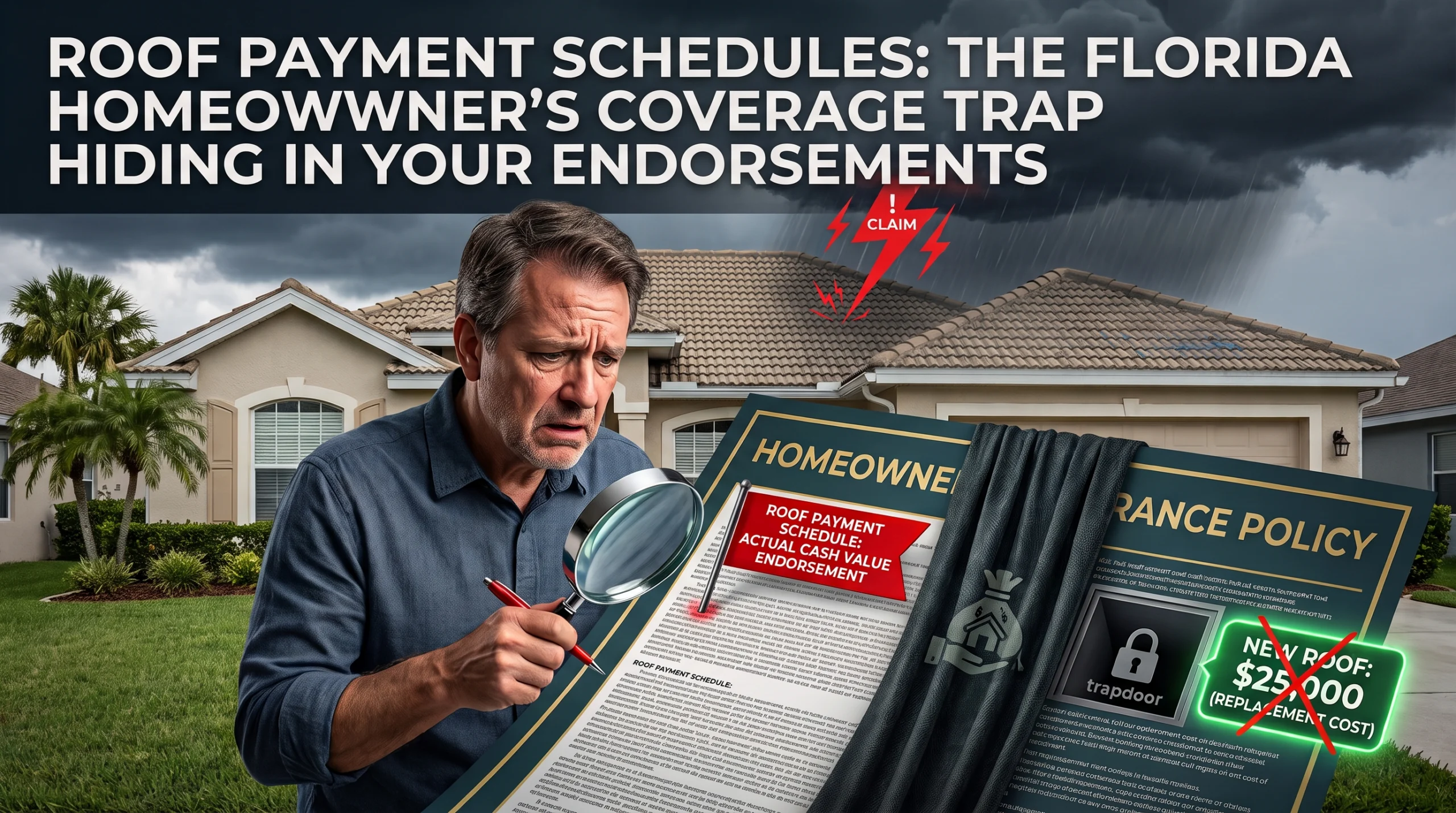
A hurricane clips Jacksonville. Your roof takes real damage. The adjuster writes it up at $18,000 to replace. Then the check arrives for $7,200.
Nothing went wrong with the claim. Your policy did exactly what it said it would do — you just never knew it said that. Buried in your endorsements is a roof payment schedule, and it quietly rewrote your “replacement cost” coverage into something much smaller.
If you own a home in Florida, this is one of the most important things you can check on your policy before storm season peaks.
What Is a Roof Payment Schedule?
A roof payment schedule — you may also see it called a roof surface payment schedule, scheduled roof settlement, or a roof reimbursement schedule — is an endorsement that caps what your insurer pays for a damaged roof based on two variables:
- The age of the roof at the time of loss
- The roofing material (asphalt shingle, metal, tile, wood shake)
Instead of paying what it actually costs to put a new roof on your house, the carrier pays a set percentage of that cost. The older the roof, the smaller the percentage. The homeowner covers the rest.
Here is the part that catches people: the declarations page may still say Replacement Cost for Coverage A. The schedule lives in a separate endorsement form, and it overrides the dwelling settlement basis for the roof only. So the policy reads like full replacement cost right up until the moment you file a roof claim.
Three Ways a Roof Can Be Settled
| Settlement Basis | What You Get | Your Exposure |
|---|---|---|
| Replacement Cost (RCV) | Full cost to replace the roof, less deductible | Deductible only |
| Actual Cash Value (ACV) | Replacement cost minus depreciation the adjuster calculates | Deductible + all depreciation |
| Payment Schedule | A fixed percentage set by a table in your endorsement | Deductible + whatever the table doesn’t cover |
A schedule is more predictable than ACV — you can look up your number in advance instead of arguing with an adjuster about depreciation. That predictability cuts both ways. It also means the carrier has already decided, before any loss occurs, that it is not paying to replace your roof.
What the Numbers Actually Look Like
Schedules vary by carrier, but the pattern is consistent. A typical asphalt shingle schedule looks something like this:
| Roof Age | Percentage Paid | On an $18,000 Roof | Out of Pocket |
|---|---|---|---|
| 0–5 years | 100% | $18,000 | $0 |
| 6–10 years | 70% | $12,600 | $5,400 |
| 11–15 years | 50% | $9,000 | $9,000 |
| 16–20 years | 40% | $7,200 | $10,800 |
| 21+ years | 25% | $4,500 | $13,500 |
Metal and tile roofs generally hold higher percentages longer because they have longer expected service lives. Asphalt shingle — the most common roof in Northeast Florida — depreciates the fastest on these tables. And remember, the deductible comes out on top of the shortfall, not instead of it.
Where Florida Law Stands Right Now
Florida has gone back and forth on this, and there is a lot of outdated information floating around. Here is the current picture.
The old statutory schedule is gone. Senate Bill 76 in 2021 created a formal roof surface reimbursement schedule in Florida Statute 627.7011, complete with statutory minimums — 70% for metal, 40% for concrete and clay tile, 40% for wood shake, 25% for everything else, and full replacement cost for any roof under 10 years old. Senate Bill 4-D rewrote that subsection in 2022, and those provisions are no longer in the statute.
What replaced it. Section 627.7011(5) now governs roof age rather than roof payment. A carrier cannot refuse to write or renew a policy solely because the roof is less than 15 years old. For a roof 15 years or older, the insurer must let you get an inspection first — and if that inspection shows the roof has five or more years of useful life remaining, the carrier cannot require replacement as a condition of coverage.
Roof deductibles are a separate issue. Under Section 627.701(10), carriers may offer a separate roof deductible capped at the lesser of 2% of your Coverage A limit or 50% of the cost to replace the roof, and it must come with an actuarially sound premium credit. It does not apply to hurricane losses, total losses under the valued policy law, punctures from a tree fall, or repairs covering less than 50% of the roof.
So why do schedules still exist? Because nothing in Florida law prohibits a carrier from filing its own roof settlement endorsement. Scheduled and ACV roof settlements are common in the surplus lines market and on value-priced admitted programs, and they are a big part of why one quote comes in several hundred dollars cheaper than another on the same house.
How to Check Your Own Policy in 10 Minutes
The Bottom Line
A roof payment schedule is not automatically a bad deal. For an older roof on a home the owner plans to sell soon, or for a client who genuinely cannot absorb the premium for full replacement cost, a scheduled roof can be the difference between having coverage and having none. Surplus lines carriers use them because they make otherwise uninsurable homes insurable.
What makes it a bad deal is finding out about it after the storm.
Coverage is a set of tradeoffs, and you should be the one making them — knowingly, in advance, with the numbers in front of you. That is the entire job of an independent agent.
This article is general information, not a coverage opinion or legal advice. Policy language, endorsement forms, and Florida statutes change — your own policy and current law control.
Frye Insurance Agency is an independent agency serving Jacksonville and the state of Florida.