After a car accident, one of the first questions people ask is, “Whose insurance pays for this?” The answer depends on something most drivers never think about until they’re standing at the scene: whether they live in an at-fault state or a no-fault state. The two systems handle injuries and medical bills in completely different ways — and Florida happens to be one of the states that does it differently from most of the country.
If you drive in Jacksonville or anywhere else in Florida, understanding this distinction can save you a lot of confusion (and money) after a crash. Here’s how at-fault and no-fault accidents actually work, and exactly what applies to you as a Florida driver.
What an At-Fault Accident Means
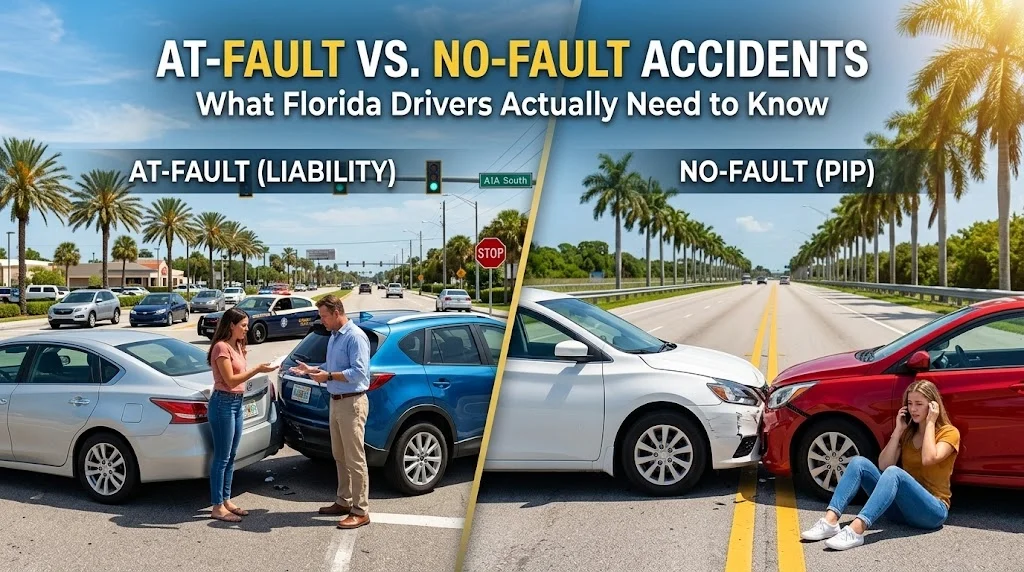
In an at-fault state — which is how most of the U.S. operates — the driver who caused the accident is financially responsible for the damage they cause. Their liability insurance pays for the other party’s injuries and property damage. This is sometimes called a “tort” system, because the injured party can hold the responsible driver liable.
In practice, that means insurers investigate the crash to decide who was at fault. Once fault is assigned, the at-fault driver’s insurance covers the other driver’s medical bills, vehicle repairs, and often other damages like lost wages. If you’re the one found at fault, expect your premium to go up at renewal — unless you carry accident forgiveness.
How Fault Actually Gets Determined
Fault isn’t decided by whoever argues loudest at the scene. Claims adjusters and, when needed, the courts look at the evidence to assign responsibility. The pieces that carry the most weight are usually:
When both drivers share some of the blame, most states use a “comparative fault” rule to split responsibility — for example, one driver might be found 70% at fault and the other 30%, with damages divided accordingly.
What a No-Fault Accident Means
No-fault works differently. In a no-fault state, after an accident each driver turns to their own insurance to cover their medical bills and certain other losses — regardless of who caused the crash. That’s the whole point of the system: to get injured people paid quickly for medical care without waiting months for a fault determination or a lawsuit.
The coverage that makes this work is Personal Injury Protection, or PIP. If two drivers collide, each one’s PIP pays for their own medical bills and a portion of lost wages, up to the limits on their policy. Property damage — the cost to fix the actual vehicles — still follows at-fault rules, so the driver who caused the crash is responsible for the other car.
What This Means for You as a Florida Driver
This is where it gets specific. Florida is one of only about a dozen no-fault states, and the rules here have some sharp edges that catch drivers off guard. If you’re insured in Florida, these are the details that matter:
Setting the Record Straight: No, Florida Didn’t Repeal No-Fault in 2026
If you’ve seen articles or social posts claiming Florida scrapped its no-fault system on July 1, 2026, ignore them. It didn’t happen. Lawmakers have filed bills over the past several years to repeal PIP and move Florida to a traditional at-fault system, but every one of them has failed — the most recent died in committee before the 2026 session ended. The only repeal that ever cleared the full Legislature, back in 2021, was vetoed by the Governor.
The bottom line: as of 2026, Florida is still a no-fault state, PIP is still mandatory under Florida Statute 627.736, and the $10,000 minimum still applies. Make your insurance decisions based on the law as it stands today — not on headlines about proposals that never became law.
How Each System Affects Your Premium
Fault still matters to your wallet even in a no-fault state. Being the at-fault driver in a crash typically raises your rates at renewal, because insurers price your risk on your driving record. No-fault simply changes who pays your medical bills first — it doesn’t erase the consequences of causing an accident.
It also doesn’t mean the state minimum is enough coverage. Because Florida doesn’t require Bodily Injury Liability, a driver carrying only the mandatory PIP and PDL can be personally on the hook if they seriously injure someone and get sued. And with so many minimally insured (or uninsured) drivers on Florida roads, Uninsured/Underinsured Motorist coverage is one of the smartest add-ons you can carry to protect yourself.
Not Sure Your Auto Policy Really Protects You? Let’s Review It.
Carrying the Florida state minimum and being fully protected are two very different things. The team at Frye Insurance can review your current auto policy, explain exactly how your PIP and liability coverage would respond after an accident, and make sure you’re not one claim away from a big out-of-pocket surprise. It’s a quick, no-pressure conversation that could make all the difference after a crash.
This article is for general informational purposes and is not insurance or legal advice, nor a guarantee of coverage.
Florida insurance laws, policy terms, limits, and exclusions can change and vary by carrier. Contact Frye Insurance for guidance specific to your situation.