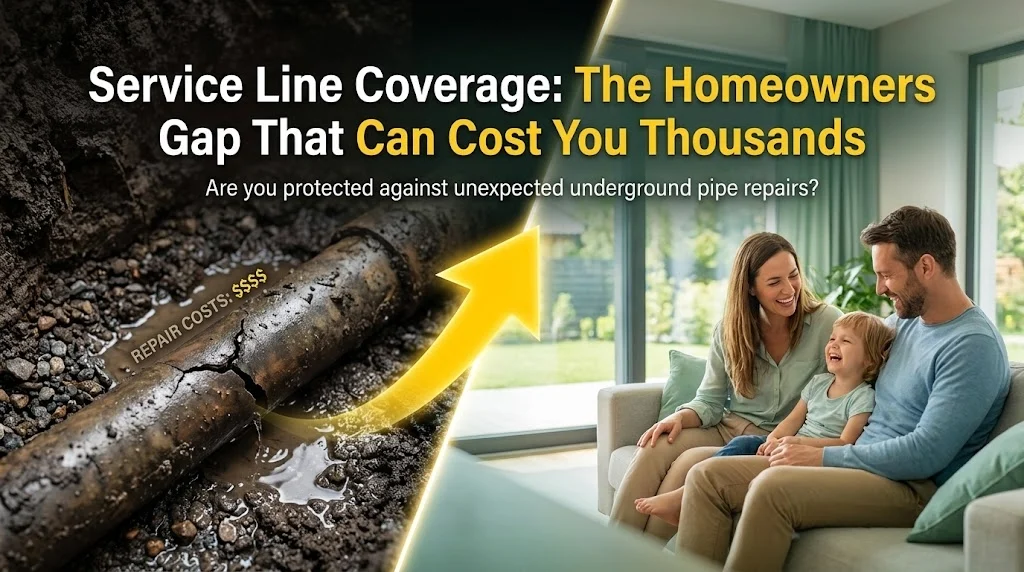
Here’s a scenario that plays out more often than most Jacksonville homeowners realize: the sewer line running from your house to the street backs up, or the buried water pipe in your yard springs a leak. You call a plumber, they dig up the line, and hand you a bill for several thousand dollars. Then you call us to file a claim — and find out your homeowners policy doesn’t cover a dime of it.
That surprise catches a lot of people off guard, because it feels like something insurance should cover. The good news is there’s an inexpensive fix most homeowners have never been told about: service line coverage. Here’s what it is, what it protects, and why it matters more in Florida than almost anywhere else.
What Service Line Coverage Actually Is
Service line coverage — sometimes called buried utility line coverage — is an optional endorsement you add to your homeowners policy. It pays to repair or replace the underground lines that run between the public connection point (the street, the meter, the utility’s main) and your home when they’re damaged.
Most people assume the water, sewer, and power lines serving their house are the utility company’s problem. They’re not. Once those lines cross your property line, the portion on your land is almost always your responsibility — and that includes the cost to dig them up, fix them, and put your yard back together afterward. Service line coverage steps in exactly where your base homeowners policy stops.
What It Covers
Coverage varies by carrier, but a typical service line endorsement protects the buried lines serving your home — and, just as importantly, the cost to reach them:
Common causes of damage that these endorsements typically respond to include corrosion and normal wear, tree-root intrusion, freezing, pest and rodent damage, the weight of vehicles or equipment pressing down on a line, and mechanical or electrical breakdown.
What’s Usually NOT Covered
Service line coverage is broad, but it isn’t unlimited. Knowing the exclusions up front keeps expectations realistic:
Why Your Homeowners Policy Won’t Pay for This
This is the part that surprises people. A standard homeowners policy is built to cover sudden, accidental damage to your dwelling and belongings — a kitchen fire, a burst pipe inside the wall, wind tearing off shingles. But buried service lines fail for reasons the base policy specifically excludes: gradual wear, corrosion, deterioration, and root intrusion. Those are treated as maintenance, not covered perils.
So when the sewer lateral in your front yard finally gives out after 40 years underground, your homeowners policy sees “wear and tear” and declines — and the cost lands entirely on you. That’s the precise gap the service line endorsement is designed to close. It’s a small add-on that converts a several-thousand-dollar out-of-pocket surprise into a manageable deductible.
The Repair Bills Are Bigger Than You’d Think
The reason this coverage is worth it comes down to the numbers. Getting to a buried line and fixing it is expensive work. Industry figures put the average sewer main repair around $2,500 — and a full sewer line replacement can run anywhere from roughly $3,000 to $25,000 depending on depth, length, and what has to be dug up to reach it. Water and electrical line repairs can climb quickly too once excavation is involved.
Against numbers like those, an endorsement that often costs just a few dollars a month is one of the highest-value add-ons in a homeowners policy.
Why This Matters Even More in Florida
Florida homeowners face a few conditions that make buried line failures more likely, not less:
Not Sure If You Have Service Line Coverage? Let’s Check.
Most homeowners have no idea whether this endorsement is on their policy — until a line fails and it’s too late to add it. The team at Frye Insurance can review your current homeowners policy, tell you exactly where you stand, and add service line coverage for a few dollars a month if you don’t already have it. It’s a quick call that could save you thousands down the road.
This article is for general informational purposes and is not insurance advice, nor a guarantee of coverage. Policy terms, endorsements, limits, and exclusions vary by carrier. Contact Frye Insurance for guidance specific to your home and situation.